Category Archives: Tests and Assessments

2022-06-12
by Hermes cApStAn
cApStAn in Paris at a FLIP+ meeting, a space to share knowledge and best practices in e-assessments
cApStAn co-founder Steve Dept was in Paris on June 9-10, 2022, at a meeting of the FLIP+ Association, a group of public institutions who switched from pencil-and-paper to computer-based assessment (CBA) for their national examinations, or who are introducing digital central assessments for the first time. The acronym? The first four participants were France, Luxembourg, …
Read More
2022-05-31
by devasmita.ghosh@capstan.be
Disentangling Proficiency in Programming from Proficiency in English: Codility meets cApStAn
by Pisana Ferrari – Branding and Social Media Manager If the level of language proficiency of a skills assessment is too high, this may hamper the correct measuring of these very skills. For example, a skilled programmer may not pass a test due to the high threshold of English proficiency that is required in order …
“Disentangling Proficiency in Programming from Proficiency in English: Codility meets cApStAn”
Read More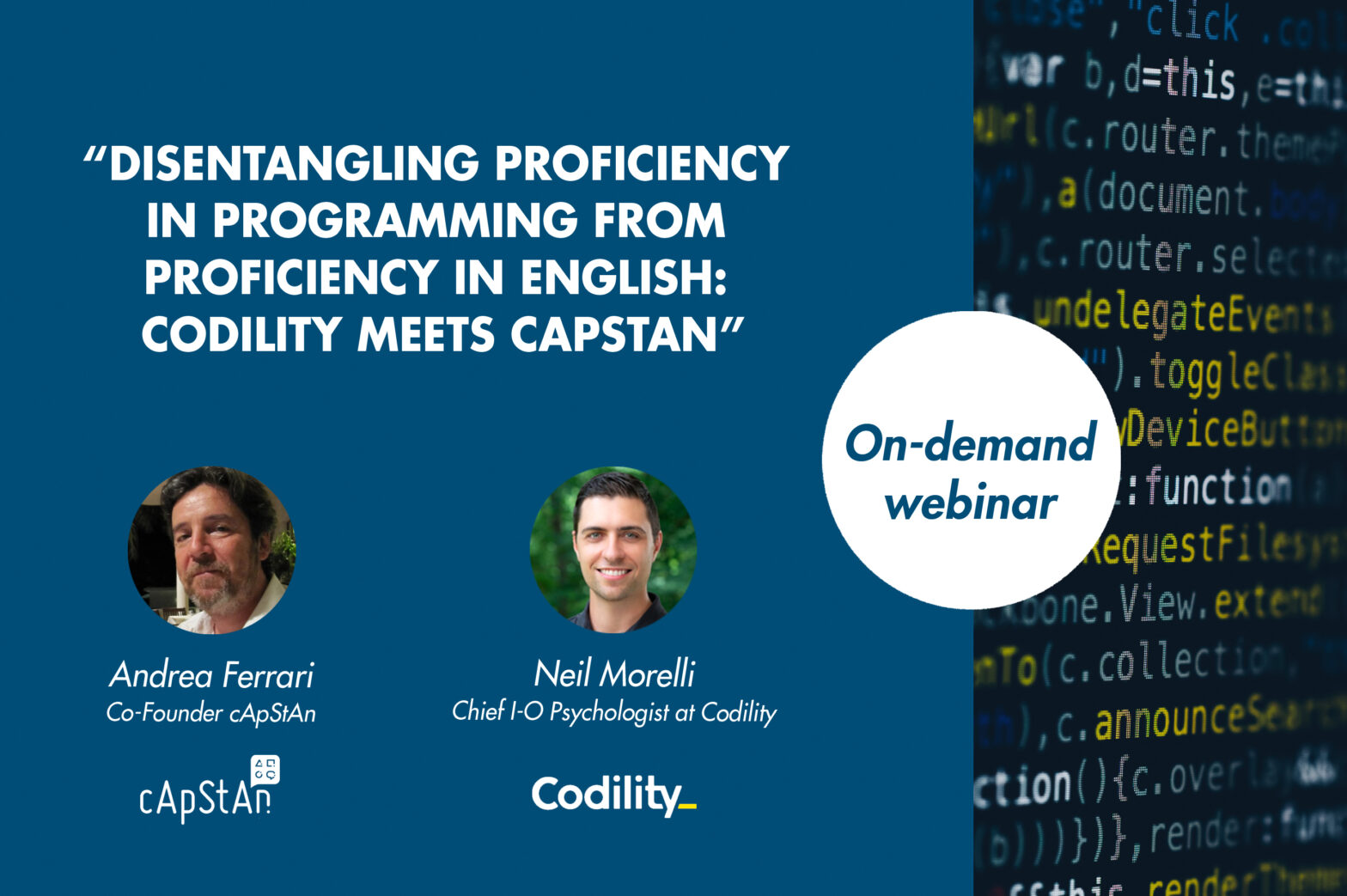
2022-05-19
by Hermes cApStAn
On-Demand Webinar | Disentangling Proficiency in Programming from Proficiency in English: Codility Meets cApStAn
Codility is the #1 rated recruitment platform for developers, helping world-class companies the likes of Microsoft, Intel and American Express to assess candidate programmers via skills-based coding tests. The tests are administered in English, but often the candidates are not native English speakers. Hence the “pain point” identified by Codility: a too high level of …
Read More
2022-05-02
by savita.gauchan
How can you create culturally fair content for tests and surveys?
by Marielle Lerner – Localization Specialist Lost in adaptation If you are involved with the production of international surveys or assessments, you have likely observed the “lost in translation” phenomenon in action. On the other hand, you may have never heard the expression “lost in adaptation”, something that we at cApStAn are always thinking about …
“How can you create culturally fair content for tests and surveys?”
Read More
2022-04-21
by Hermes cApStAn
On-Demand Webinar |Translatability Assessment
A translatability assessment (TA) is a tried and tested method to optimize the master version of your assessment or survey questionnaire before the actual translation and adaptation process begins. In many multilingual tests or surveys—not only PISA or PIAAC or Pew Research Center’s Global Attitudes Project—the TA has become an important design step. The TA process increases …
“On-Demand Webinar |Translatability Assessment”
Read More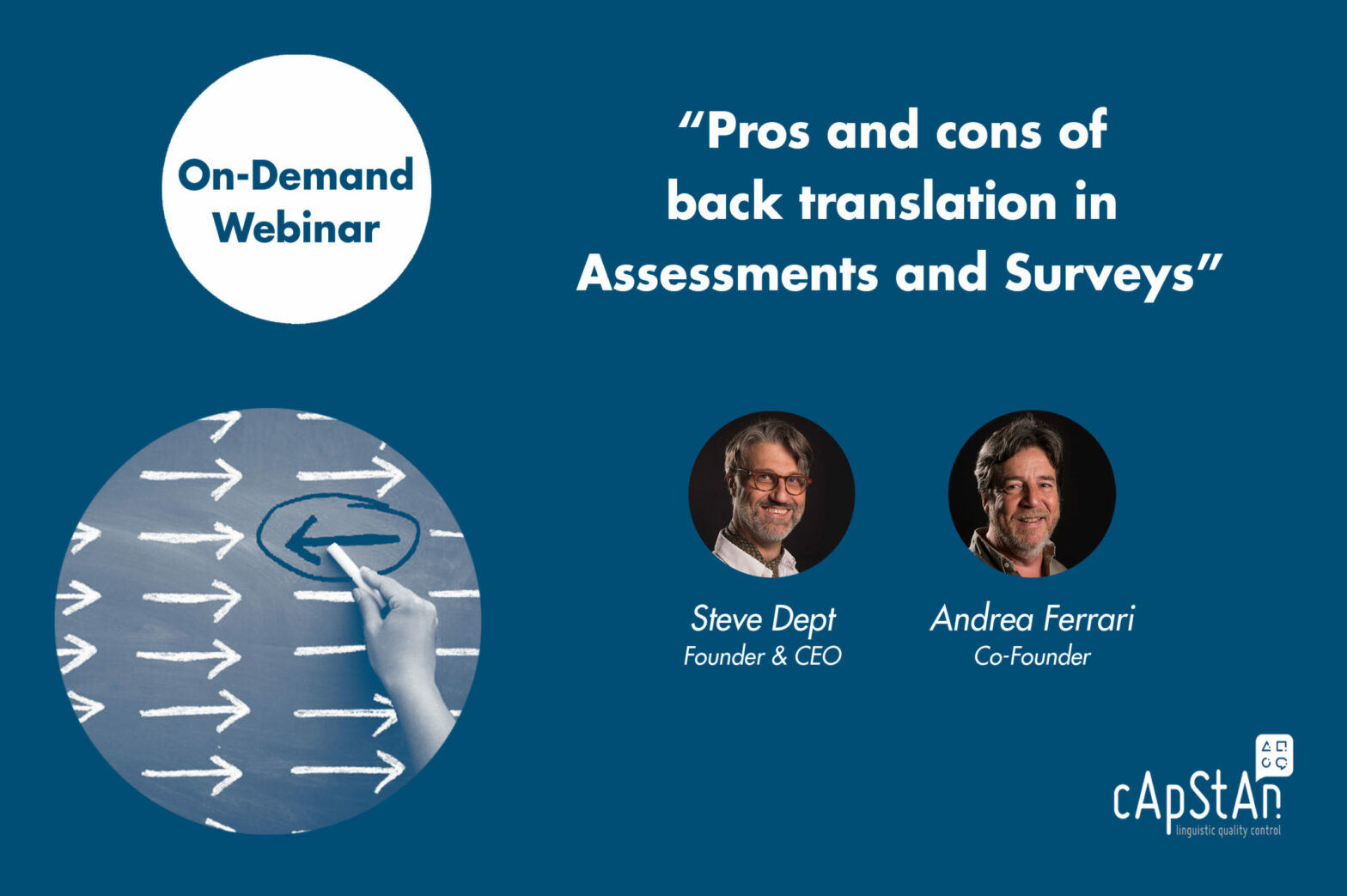
2022-04-12
by savita.gauchan
On-Demand Webinar| Pros and cons of back translation in assessments and surveys
Pros and cons of back translation in assessments and surveys A webinar by Andrea FERRARI and Steve DEPT, the founders of cApStAn Linguistic Quality Control. In 45 minutes, they will tell you everything you always wanted to know about back translation but never dared to ask such as: Telling examples from international studies – for which Andrea and Steve were commissioned …
“On-Demand Webinar| Pros and cons of back translation in assessments and surveys”
Read More
2022-03-18
by Hermes cApStAn
On-Demand Webinar | Pitfalls to Avoid while Translating Psychometric Assessments
Psychometric assessments have become a crucial component of the recruitment and development process at scale. To hire the right candidate, one needs to ensure that the tests are fair, valid, reliable and defensible in all the languages that are available to the test takers. Different types of assessments present different challenges, and we shall show …
“On-Demand Webinar | Pitfalls to Avoid while Translating Psychometric Assessments”
Read More
2022-03-08
by Hermes cApStAn
PISA launch event in Uzbekistan | Translation of PISA Assessments – the Gold Standard within reach of National Centers
The State Inspectorate for Supervision of Quality in Education (SISQE), Uzbekistan in collaboration with the Ministry of Public Education, National Center for International Studies on the Assessments of Quality in Education, OECD, UNICEF, World Bank, UNESCO are organizing a in-person/virtual hybrid conference on 11-12 April, 2022 to launch and commemorate Uzbekistan’s participation in PISA 2022 …
Read More
2022-02-24
by Hermes cApStAn
On-Demand Webinar – Tests, Assessments and Surveys: Item-by-item translation and adaptation notes
You need to deploy a test or questionnaire in multiple countries and languages? The reliable validation of translated data collection instruments requires—among other things—a robust QA design. A design that focuses on equivalence, comparability as well as appropriateness in each target culture. Based on +20 years of experience as LQA practitioners, Steve and Andrea profess …
“On-Demand Webinar – Tests, Assessments and Surveys: Item-by-item translation and adaptation notes”
Read More
2022-02-16
by savita.gauchan
How to avoid the hidden threats to translation quality in computer-based assessments
by Steve Dept, cApStAn CEO In the first two decades of this century, many test providers have migrated from pencil-and-paper assessments to computer-based assessments and this has driven a surge in sophisticated testing platforms. In some of these computer-based assessments environments, however, scant attention was given to multilingual testing. What many stakeholders do not seem …
“How to avoid the hidden threats to translation quality in computer-based assessments”
Read More
2022-01-26
by Hermes cApStAn
On-Demand Webinar | How to leverage CAT tools to achieve more savings than MT
Computer-assisted translation tools (CAT tools) have been around for 30 years, and they are designed as productivity tools for professional translators. Using CAT tools effectively increases quality, consistency and productivity at scale. Term bases, style guides and translation memories form a powerful combination that (still) give the human translator a competitive edge in terms of quality/price …
“On-Demand Webinar | How to leverage CAT tools to achieve more savings than MT”
Read More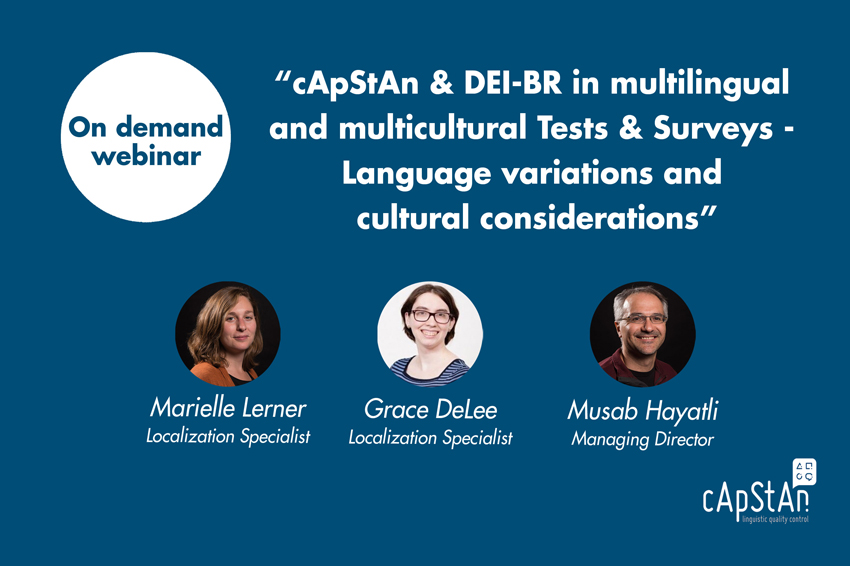
2021-11-30
by savita.gauchan
Why you should include DEI-BR filters in your multilingual tests, assessments and surveys — and how cApStAn can support you
by Pisana Ferrari – cApStAn Ambassador to the Global Village Cultures and societies are dynamic and so is awareness of social justice issues. Recent global movements such as #metoo and #blm have shone a light on many of the inequities in the world and highlighted the need to work towards a more inclusive society. Awareness …
Read More