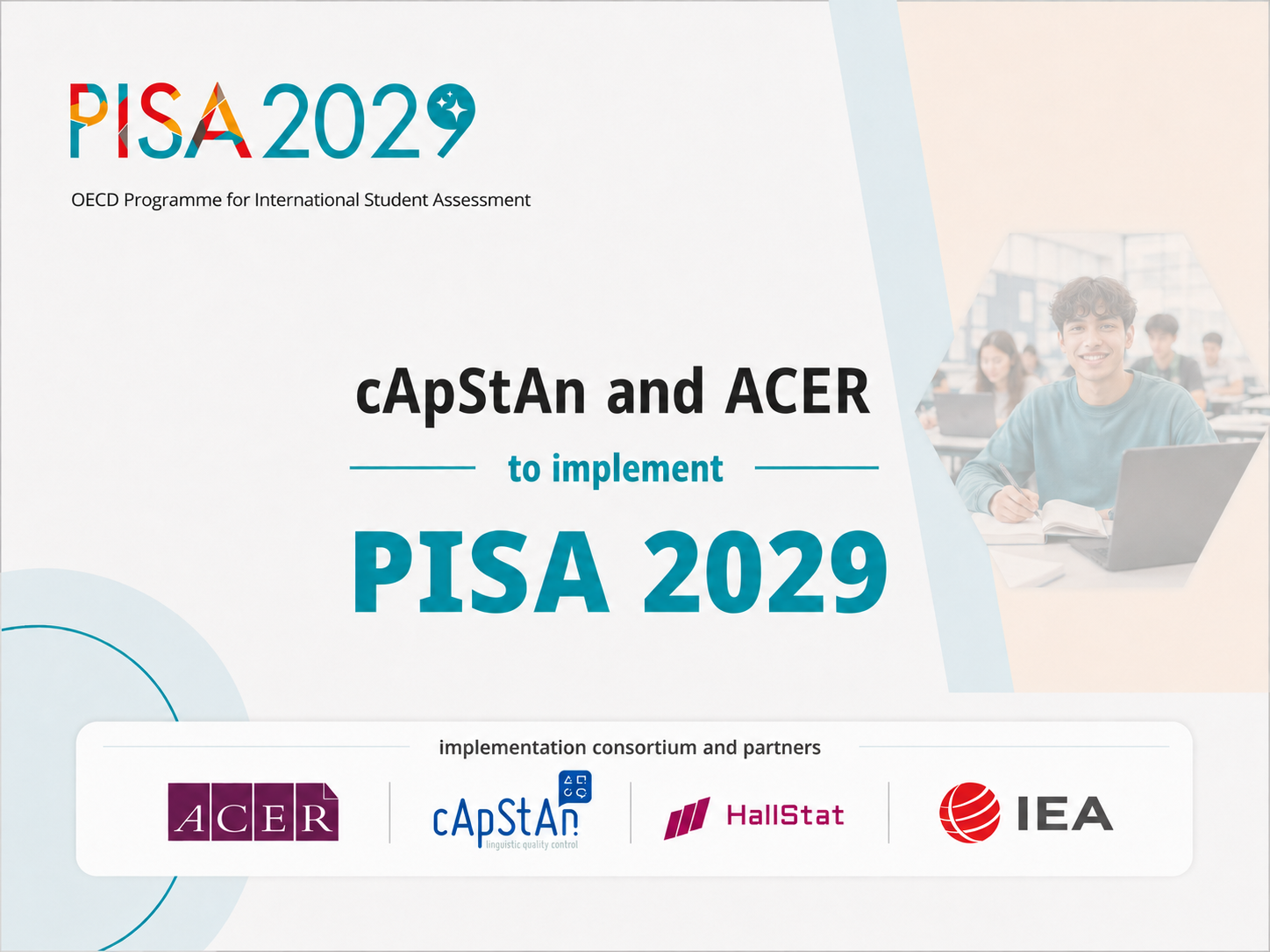
cApStAn and ACER to implement PISA 2029
03 June 2026: For the 10th consecutive time, cApStAn will guide the translation and adaptation teams of all PISA participants in translating assessment instruments so that they remain comparable internationally. In this cycle, we shall introduce secure automated translations as part of a sophisticated double translation design. cApStAn will provide training and support to 90+ translation teams and ensure linguistic equivalence between the international source version and 120+ national versions.
PISA 2029 is the tenth survey cycle of the Organisation for Economic Co-operation and Development (OECD) Programme for International Student Assessment (PISA), the leading education survey that measures education outcomes around the world and links them to a variety of contextual variables, so as to provide relevant, meaningful and actionable data to education stakeholders and policy makers. In this cycle, reading is the focal domain, while media and AI literacy (MAIL) is the innovative domain.
The Lead contractor for PISA 2029 is the Australian Council for Educational Research (ACER), with whom cApStAn has already partnered for 6 PISA cycles and for many other surveys and assessments. The International Association for the Evaluation of Educational Achievement (IEA) will be responsible for sampling. In close collaboration with ACER and Translation Referee Béatrice Halleux, cApStAn’s role includes:
- evaluating the translatability of newly developed materials;
- producing a French reference version in parallel with the English source version;
- designing and testing the translation, adaptation and verification workflows;
- preparing translation and adaptation guidelines and item-by-item notes;
- providing a secure automated translation of the survey instruments in each PISA language;
- providing training and support to 90+ translation teams, so that they can make the most of an online translation editor;
- ensuring linguistic equivalence across 120+ locales;
- monitoring adherence to technical standards.
The cApStAn team looks forward to working together with some of the world’s most knowledgeable experts in educational assessment: we verified over 24 million words of content in 52 different languages in PISA 2025, and are in the starting blocks to assist all PISA Participants from the outset in PISA 2029, with a special focus on capacity-building in less experienced teams. cApStAn co-founder Steve Dept said that “PISA has been one of our flagship projects, a laboratory for best practice. Collecting gold standard data depends on applying gold standard methodology, and PISA provides the opportunity to further improve translation workflows in a production environment and on a very large scale. In this cycle, we plan to generate automated translations in support of the human-centred design, and we shall collect data on the relevance and usability of automated translation for the translation teams. In this technology-rich environment, we remain committed to maximising comparability of assessments and questionnaires across languages, across modes and over time.”
Please view PISA 2029 brochure here.