What gets measured, gets treasured | ACE Summit 2025, Paris
What gets measured, gets treasured – Post by Steve Dept, cApStAn’s founder
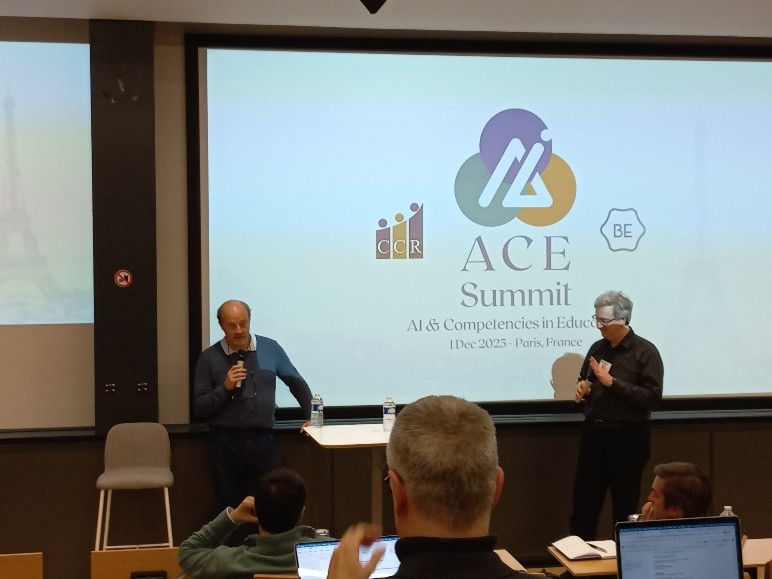
On December 1st, I had the privilege of attending the ACE Summit 2025 at the Learning Planet Institute in Paris. The “ACE” acronym stands for AI & Competencies in Education, and the organisers are Beyond Education and the Center for Curriculum Redesign (CCR). I had come because there has been a steadily increasing demand to assess transversal skills such collaborative problem-solving, critical thinking or creativity, and this forum featured a high concentration in speakers, researchers and visionaries who developed conceptual frameworks to assess and measure these competencies. I’ll quote Michaela Horvathova, Co-founder and CEO of Beyond Education, who reminded us that “what gets measured, gets treasured” and aptly set the stage with a set of crucial questions:
- What capacities will humans need when machines do almost everything?
- How do we cultivate explorers—not just achievers?
- What does it mean to measure what truly matters?
- What kind of society do we want to build?
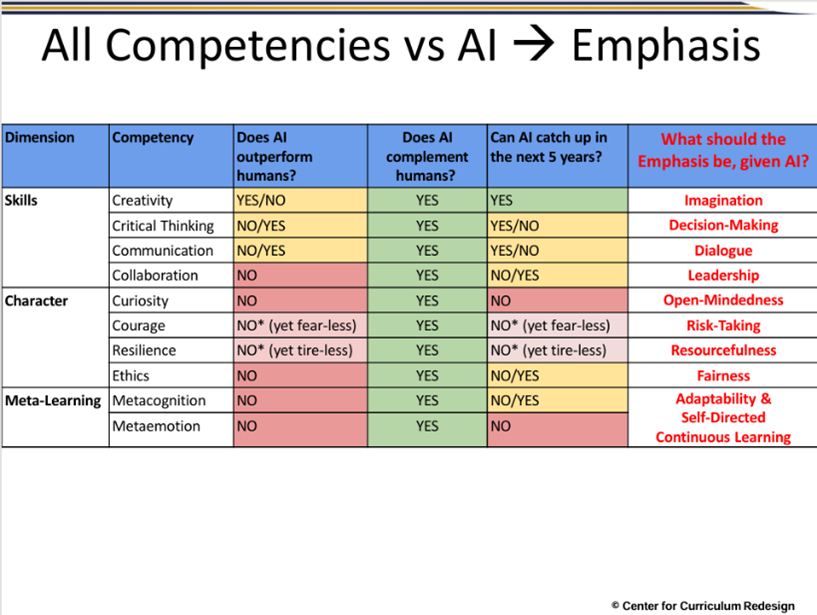
Charles Fadel, the Founder and chairman of the Center for Curriculum Redesign (CCR), followed suit with his usual brand of keynote: striking images and data visualisations drawn from multiple sources, a rapid-fire combination of high-level history of technology, including generative AI, and projections leading to the presentation of CCR’s 4D Framework: robust psychometric research underpins embeddings of competency dimensions into the different knowledge strands, and a summary of the status of each competency with regard to AI.
The audience participation was already gaining momentum and would continue to do so throughout the day.
UNESCO’s roadmap and an interactive panel
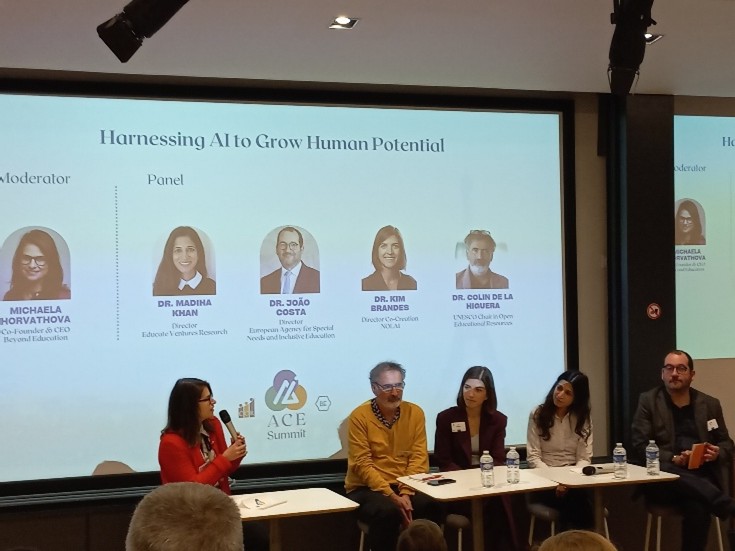
Dr Shafika Isaacs, the UNESCO Chief of Section for Technology & AI in Education, set out UNESCO’s twin AI competency frameworks for teachers and students, which both follow the same “understand – apply – create” progression. Progression conjures up growth, and the panel that followed discussed ways to harness AI to grow human potential: Dr Madikha Khan (Educate Ventures Research), Dr João Costa (European Agency for Special Needs and Inclusive Education, former Minister of Education of Portugal), Dr Kim Brandes (NOLAI) and Dr Colin de la Higuera (UNESCO Chair in Open Educational Resources) provided a vivid discussion, in which the ethical dimension was front-stage throughout.
Thought-provoking PISA and TALIS data
The guest speaker after an onsite networking lunch was none less than Dr Andreas Schleicher, the Director for Education and Skills at the OECD. It was great to have a synthesis of relevant data from the OECD’s Programme for International Student Assessment (PISA) and Teaching and Learning International Survey (TALIS), two projects for which cApStAn Linguistic Quality Control has contributed to maximising cross-language and cross-country comparability of the data collection instruments. We learnt, for example, that some countries do much better in creative thinking than one would expect based on those countries’ performance in mathematics.
The research that goes into the frameworks and their implementation
Robbie Taylor, Head of Research at CCR, and Dr Nathan Robertson, Head of Research at Beyond Education, both showed us what is under the hood in the frameworks and assessments they use to collect date and use that evidence for continuous improvement. Competency-based learning is gaining traction, and it is promising to see how robust the underlying research is. This was a good stepping stone for the much-awaited conversation between two titans, François Taddei (the Founder of the Learning Planet Institute) and Charles Fadel. Two visionaries vying to ensure that it remains possible to make the world a better place and to embed that notion in education, so that tomorrow’s graduates are equipped to take that dimension into account throughout their educational career.
Best practices, and an inspirational conclusion
After a coffee break, five distinguished practitioners shared how they actually assessed key competencies in their schools or organisations. Déspina Sarioglou reported on that journey in the Beyond International School in Portugal, where she is the Principal, and a panel consisting of Icíar García Montenegro (Principal, Affinitas, Spain), Afonso Mendonça Reis (Founder of Mentes Empreendedoras, Portugal), Dr Fatma Odaymat (ARIS, Ghana) and Susanne Østegaard Olsen (Business Academy Aarhus, Denmark) shared their experiences.
The closing session was an inspirational exercise led by Julie Jungalwala, the Founder and Director of the Institute for the Future of Learning.
A day packed with insights, exchanges, data and questions, every moment worthwhile. We’ll be back next year.