Harver Case Study: Tailored Localisation Workflow for Psychometric Assessments
About the client
Founded in 2015, Harver delivers automated solutions that optimize talent-related decisions for organizations. They help organizations to engage, hire, and grow the right talent in a fast and fundamentally unbiased way. Their solutions include assessments, video interviews, scheduling, and reference checking.
Scenario
Over the years, we have supported Harver with their translation needs in up to 31 languages across a wide range of content types, including:
1. Assessment questionnaires
2. Situational judgment tests (SJTs) and subtitling files
3. UI strings, email templates, legal content and development reports
To best meet the needs of each content type, we have adopted two main approaches:
- Standard professional translation + revision
- Machine Translation (MT) + Post-Editing (MTPE) + Proofreading
We primarily apply the standard translation workflow to the first and second types of content, and the MTPE workflow to the third type, for the following reasons:
Cultural and contextual sensitivity – The first and second types of content require nuanced understanding, cultural adaptation, and context-sensitive phrasing to ensure that the intended meaning and tone are accurately conveyed. These materials therefore follow the standard human translation and revision process to preserve both linguistic and conceptual integrity.
Nature of content – The third category typically consists of standardized, repetitive text with predictable syntax and terminology that already has established equivalents in the target languages, which makes it highly suitable for MTPE.
Efficiency and scale – The third type of content often involves large volumes (typically exceeding 10,000 words). Using MT significantly accelerates turnaround time while maintaining quality through the subsequent post-editing and proofreading steps.
Workflow analysis
Machine Translation (MT) + Post-Editing (MTPE) + Proofreading
The Project Manager pre-processes the files before applying MT — sorting out tags and links, locking repetitions, and checking for translation memory (TM) matches to ensure optimal leverage. Once our internal MT engine generates the initial output, the PM reviews it and provides clear instructions for post-editors and proofreaders.
Given the high volume of such projects, detailed segment-level translation notes are replaced with general guidelines that cover tone, register, formality, and gender usage. The PM also highlights ambiguous or context-sensitive segments where machine translation is more likely to produce errors. This way the linguists can focus their attention on where it matters most.
After the two human review stages, the PM performs a final quality control check to address any tag, formatting, or consistency issues. This structured workflow allows us to deliver large-scale projects within tight timelines while maintaining a high level of linguistic accuracy.
Standard professional translation + revision
Before translation begins, the PM draws up an initial set of guidelines identifying potentially ambiguous segments and questions for the client to clarify. The client’s response is then incorporated in the guidelines, which ensure that the linguists fully understand the expectations and context before work begins.
Throughout translation and revision, linguists are required to leave detailed comments explaining any significant edits, cultural adaptations, or interpretation choices. The PM consolidates this feedback and includes it in the final delivery, which allows the client to see how specific translation decisions were made. Any linguistic or cultural recommendations are clearly flagged for the client to identify areas that may need further review post-delivery.
Standard professional translation + revision + client review + subtitling files conversion
This workflow is specifically applied to Situational Judgment Tests (SJTs) and subtitling files, where the client’s stakeholders or country representatives often have detailed requirements regarding register, terminology, and tone.
After completing the standard professional translation and revision process, we introduce an additional client review step. During this phase, the client’s local representative reviews the translations and provides targeted feedback to ensure that the tone and cultural nuances align with their expectations.
Once feedback is received, our linguists review the client’s comments and revise the translations accordingly to ensure that the final version meets both linguistic quality standards and the client’s internal requirements. After the client’s final approval, we proceed with subtitling file conversion, adapting and formatting the SRT files into the respective target languages.
The following steps illustrate the SRT file conversion process:
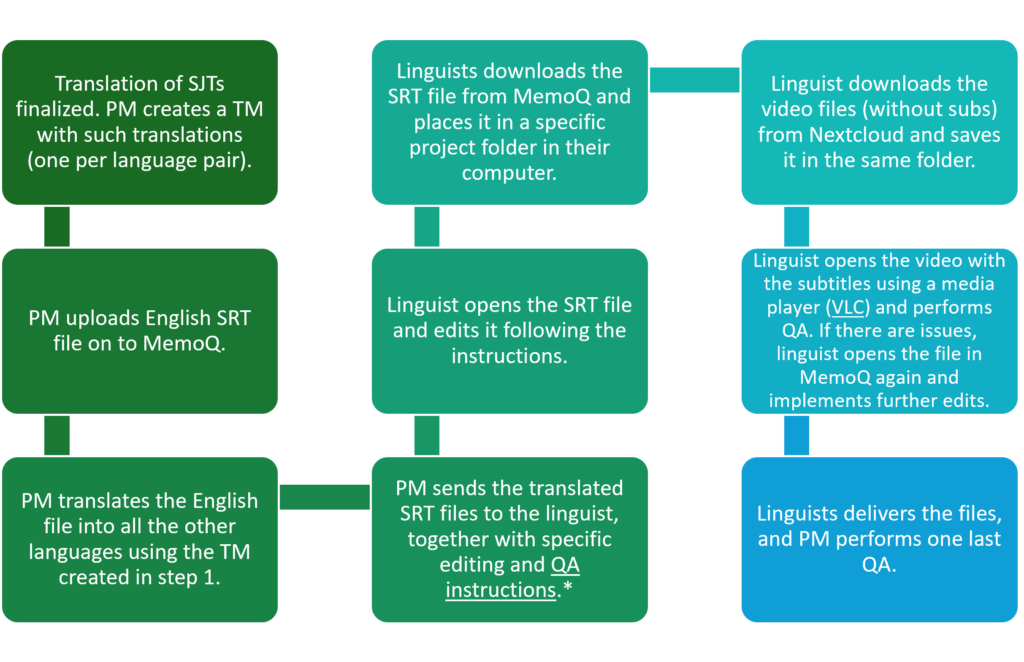
Below are some QA instruction examples mentioned in the workflow:
- No subtitle line should be longer than 37 characters. If a segment is longer, split it into different segments.
- Reading speed should not be over 14 characters per second.
- Merge and split segments as needed to create appropriate units of meaning.
- If a sentence is too long, follow these basic principles to break it into different segments:
- The segment should be broken:
- after punctuation marks
- before conjunctions
- before prepositions
- The segment should be broken:
- The segment break should not separate:
-
-
- a noun from an article (a physician)
- a noun from an adjective (huge amounts)
- a first name from a last name (Dr. Rose Smith)
- a verb from a subject pronoun (I have always been)
- a prepositional verb from its preposition (he’s going through)
- a verb from an auxiliary, reflexive pronoun or negation (it is not)
-
Challenges
Throughout our collaboration with the client, we encountered a few challenges that required careful planning and transversal coordination:
MT quality variation: The quality of machine translation output differed significantly across languages. While some widely used languages yielded good results, rarer or linguistically complex languages required more extensive post-editing and human intervention. To address this, we regularly evaluated multiple MT engines and selected the most suitable one for each target language to optimize quality and efficiency.
Content diversity: The client’s materials covered a wide range of domains from UI strings and legal texts to assessments and SJTs. Each requires different linguistic approaches and quality control methods.
High volume and turnaround pressure: Large-scale content updates needed to be delivered within tight timelines while maintaining consistent quality across all languages.
Client review alignment: Coordinating with multiple country representatives during the client review phase required clear communication and a structured feedback process to meet both linguistic quality standards and the client’s internal requirements.
Conclusions and Outcomes
Through our tailored workflows and close collaboration with the client, we successfully streamlined their multilingual production processes while maintaining high linguistic accuracy and cultural relevance across all target markets. Our scalable approach has enabled efficient delivery of large volumes of content without compromising on quality or stakeholder alignment.
As our partnership continues, we remain committed to supporting the client in their ongoing global initiatives and contributing to their success in reaching diverse audiences with clarity.
Client Testimonial
“Thank you so much, Devasmita and Liruo — you both did a great job! I also want to highlight how supportive cApStAn has been whenever new suggestions were introduced. The process has become much smoother thanks to your flexibility and cooperation.”
Want to try this out on your materials?
Select some sample items, and request a free pilot at hermes@capstan.be or contact us via the form below for more details.