
European Quality of Life Survey (EQLS) 2026
About the Survey
The European Quality of Life Survey (EQLS) conducted by European Foundation for the Improvement of Living and Working Conditions (Eurofound) collects data on the living conditions and social situation of Europeans, and how they perceive those circumstances and their lives in general.

Project Scope
A consortium led by cApStAn carried out the translation of a questionnaire for all EU countries, covering 25 European languages. cApStAn and their partner Stoquart applied an innovative variant of the rigorous TRAP-D methodology (Translation-Review-Adjudication-Pre-test-Documentation): a double translation with one automatically generated translation and one professional human translation, followed by reconciliation, adjudication and proofreading steps. The mission statement: to ensure high linguistic and conceptual equivalence across all versions. An adaptation step was applied to all “shared-languages”, for example, the Dutch questionnaire for Belgium was adapted from the Dutch version for the Netherlands.
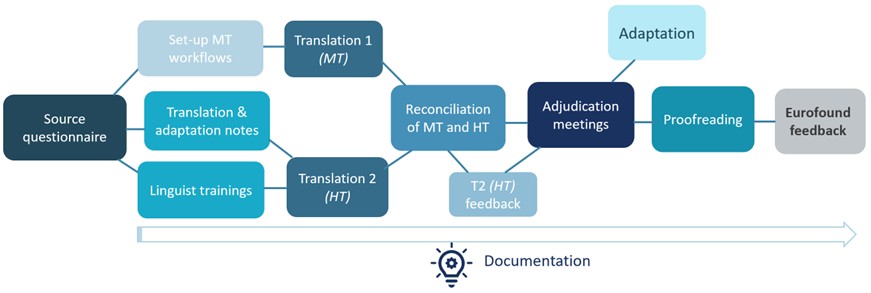
*HT – Human translation
*MT – Machine translation
Challenges
Translating for different modes
Eurofound will use two self-completion modes in its 5th survey edition: participants are asked to complete the survey online, but a paper version is available for those who can’t or don’t want to fill in the questionnaire online. In four countries – Bulgaria, the Netherlands, Poland, and Slovenia –there will also be 700 face-to-face interviews in addition to the self-administration modes.
The English source questionnaire was initially designed to be mode-agnostic, i.e. to be suitable for different survey modes. cApStAn nevertheless needed to adapt components such as prompts and instructions on the basis of the method used. Making these adjustments was often more difficult in other European languages than in English.
Machine Translation (MT) in TRAP-D workflow
For the very first time, double translation included only one human translator, while the second was produced automatically, thus experimenting with a variant of the traditional TRAP-D model.
Worth noting, cApStAn first proposed the integration of MT into TRAP-D workflows at a symposium organized by the OECD and GESIS in Paris in 2018.
While MT content was mostly accurate and clear – only Luxembourgish required post-editing –, it sometimes lacked the perspective, local context and creative insight that a human linguist can provide. During online adjudication meetings, two linguists – a Translator and a Reconciler – contributed their expertise to craft a version that resolves such issues.

Conveying exact meaning
Questions and items addressing socially sensitive topics were challenging to translate or adapt. Detailed feedback from the questionnaire authors helped guide the linguists, who then discussed this feedback during adjudication meetings, bringing their own perspectives on these sensitive questions according to their country’s local context.
Example 1
Survey question: In our society there are groups which tend to be towards the top and groups which tend to be towards the bottom. Where would you put yourself now on this scale?
cApStAn question: What do “top” and “bottom” groups refer to here? Is it to identify groups with more power, wealth, opportunities, access to education, versus groups living under poverty conditions, with less opportunities and more discrimination?
Client response: It is intentionally not specified whether it is about income, education, occupation, etc. It is about subjective social status.
Example 2
Survey statement: I feel overwhelmed by the constant connectivity of online life
cApStAn question: How should overwhelmed be understood here? Not being able to keep up with the constant flow of input/demands from online sources, leading to stress/anxiety?
Client response: “Overwhelmed” implies that the constant connectivity/being always online is emotionally too much, having a strong emotional effect on the respondent.
Example 3
Survey statement: Now think about the other members of your household, starting with the oldest person other than yourself. How would you describe this person?
cApStAn question: Would it be okay to translate “How would you describe this person” as “What is the gender of this person?” in some languages where the source could be understood as how a person looks? (The response options concern gender).
Client response: Avoid using “gender”, but no need to literally translate “describe”.
As seen in these examples, feedback provided often allowed for more linguistic flexibility to ensure that respondents in all countries would understand the question as expected by the survey authors.
Outcome achieved
The resources invested upstream in identifying the potentially challenging elements and preparing translation guidelines as well as glossaries, helped to maximise cross-language comparability.
Initial screening of the source questionnaire by all participants – cApStAn-Stoquart and Ipsos project managers, English-native linguists as well as Eurofound – resulted in minor source adjustments during the translation process, helping to save time and resources.
All translations were performed in a computer-assisted translation (CAT) tool. This contributed to seamless version management, and allowed cApStAn to provide translators and reconcilers with customised translation and adaptation notes, glossaries as well as technical support.
Want to try this out on your materials?
Select some sample items, and request a free pilot at hermes@capstan.be or contact us via the form below for more details.